






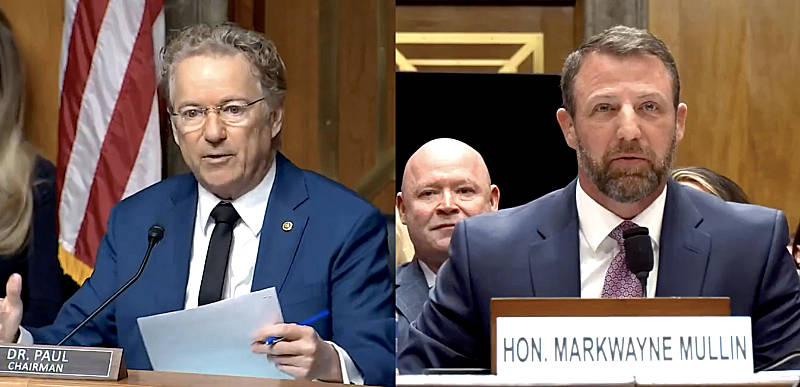
In the past year since the re-election of Donald Trump and his return to the White House in January of last year, there has been a divide building in the Republican party and conservatism more broadly. This is not surprising especially after the uniting under the Trump 2024 ticket. There was bound to be discord, as there are significant differences among this coalition built to defeat the Democrats.
The question is “Is this really a bad thing?”
Shouldn’t we question with whom we are joining forces? Should we be hand-in-hand with those who are a threat to what we actually believe just because they hold the label ‘conservative’ — whatever that means?
It is obvious that this division is necessary. This is not a body of believers. This is politics. Division is necessary. I have no issue drawing a hard line when it comes to Democrats. Their policy of unfettered abortion, their endorsement of homosexuality, and their promotion of transgenderism and other forms of moral decay make it impossible for me to even consider them at the ballot box. That does not even include their attempts to redistribute wealth, impose vaccine mandates, and expand draconian regulations.
If we are comfortable dividing from Democrats, then we should be just as willing to divide from certain Republicans or so-called “conservatives.”
The greatest factor contributing to this identity crisis on the right is the reality that our Republican president has no consistent ideology, principles, or coherent belief system. In some ways, this has benefits—it allows him to build a broad voter base and operate with a high degree of political flexibility. But what it does not do is hold together a coalition with deep ideological differences. When figures as different as Rand Paul and Lindsey Graham both endorsed Donald Trump in 2024, it was always going to be unsustainable.
The moment the bottom fell out was in the weeks following the September 10 assassination of Charlie Kirk. Kirk was a uniter among conservatives. He was a bridge-builder who maintained relationships across the right. His death removed that unifying force. Without that “glue,” the movement has increasingly turned inward, even invoking his name while tearing itself apart.
The issue that sows the most discord is foreign policy. The Republican party has been known for a hawkish foreign policy since Ronald Reagan. This neoconservative reign came to a cresciendo during the Bush-Chaney administration and the Iraq War, which was a complete and utter failure. This failure broke the republican party and led to the rise of Obama. Republican voters were sick of this style of governance and they rejected John McCain, who would’ve only been worse than Bush. And in my opinion, he would have been worse than Obama, as McCain was also a liberal on social issues.
Neoconservatism made the republican party useless. Enter Ron Paul. The “Ron Paul Revolution” hit the Republican primaries in 2008 and 2012. The anti-war, anti-spending, anti-surveillance campaign of the libertarian Paul invigorated a base of voters. This base of voters never became big enough to take over the Republican party, but it did set the groundwork for the hostile takeover from an outsider.
Donald Trump came in in 2015 declaring that the Iraq War was a mistake and that George W. Bush was “stupid’ in his handling of the war. This type of talk and push against the establishment made certain people hate him but made others flock to him, allowing him to dominate the primaries and upset Hillary Clinton in the general election. Trump did not win on a neoconservative platform. He dissented. It turns out, Donald Trump does not believe in anything. He now operates a conflict with objectives eerily similar to those in 2003.
This brings us to Rand Paul and Markwayne Mullin.
Rand Paul of Kentucky is the son of Ron Paul and won his seat in the U.S. Senate in 2010. 2010 was the year the “Tea Party” came into congress. Rand Paul is in the same line as his father in terms of ideology but differs slightly in tactics. Rand Paul finds himself in a bind as he has had agreements with Trump but he irritates the president as he does not support him when he spends like a democrat.
Markwayne Mullin is a senator from Oklahoma who has a background in blue-collar work as he expanded his father’s plumbing company into being a big regional company in Oklahoma and Texas. This propelled him into the House of Representatives and he was then elected into the U.S. Senate in a special election in 2023. Mullin was recently nominated to be the Secretary for the Department of Homeland Security by President Trump.
Mullin and Paul do not see eye to eye. Mullin’s past comments regarding the assault on Paul—suggesting he “understood” the attacker’s motivations—created a lasting rift. For Paul, this was not merely a rhetorical misstep but a serious concern about judgment and respect for political opposition. This was after Paul dissented on a big republican spending bill.
Paul has not forgotten.
Now as Mullin walks into the committee room begging for the support of the security committee. Paul stands in his way and does not support Mullin as he says that he has shown that he supports violence against political opponents.
Is this relevant to confirmation as DHS secretary? Absolutely. This department is already under scrutiny for violence that has been deemed unjustified. If you have a secretary of this department that is bombastic and violent in language towards political opponents, that is a liability to the country.
Mullin represents the violent hawkish wing of the “conservative” movement. These are the type of republicans who despise liberalism but still have the same anger and lack of peace the left wingers possess. They love violence toward their political opponents in the same way that the left wingers loved seeing Charlie Kirk get cut down. I am a Christian, and I have been fine with identifying as a conservative in the past. But if this is what conservatism represents, count me out.